Why the Most Interesting Voices on the Internet Are Playing the Long Game
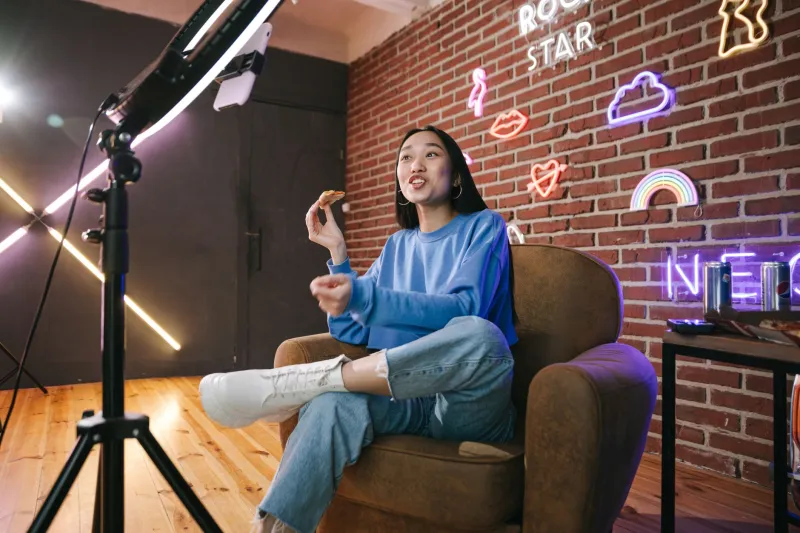
Open Instagram on any given Tuesday and you'll find the same ecosystem that's been running since approximately 2017. Aspirational lighting. Carefully distressed neutrals. A caption that either says nothing in twelve words or overshares in a way that's clearly been workshopped. A product tagged in the corner. Swipe up. Shop now. The whole operation is frictionless and, increasingly, completely forgettable.
Now open YouTube and search for any topic that genuinely interests you — philosophy, Korean history, animation theory, urban planning. Odds are decent you'll find a creator who will talk at you, with intelligence and personality, for forty-five minutes to two hours. No brand deal in sight. Comments that look like a book club got into a friendly argument. And subscriber counts that, while smaller than the mega-influencers, are made up of people who actually watch.
This is the divide that's reshaping how Gen Z relates to online content — and Asian creators are sitting comfortably on the winning side of it.
The Aesthetic Industrial Complex Is Running Out of Steam
Western influencer culture built itself on a simple promise: look at how good things can look. The aspirational lifestyle, the perfect product, the carefully curated existence. It worked spectacularly for about a decade. It made millionaires. It created entire industries around content creation as a profession.
But somewhere around 2022, the cracks became undeniable. 'Deinfluencing' went viral. Audiences started calling out the performative authenticity of 'this is my real skin' posts that were still clearly lit by a ring light and edited in Lightroom. The backlash wasn't necessarily against beauty or aesthetics — it was against the feeling of being sold something while being told you weren't.
Gen Z, raised with finely tuned marketing-detection instincts, started migrating toward creators who felt like they had something to say rather than something to sell.
Enter the YouTube Philosophers
The term is a little tongue-in-cheek, but it captures something real. A generation of creators — many of them Asian, many of them working in their second or third language — built massive audiences by going long and going deep.
Take creators like Abroad in Japan's Chris Broad, whose long-form documentary-style videos about Japanese culture and travel blend humor with genuine curiosity and have earned him over four million subscribers. Or consider the Korean-American YouTube ecosystem around creators discussing everything from chaebol culture to mental health in Asian households, often running well over an hour and pulling hundreds of thousands of views from audiences who sit through every minute.
Then there's the philosophy and essay video space, where creators like Nerdwriter1 and (increasingly) a wave of East and Southeast Asian voices are producing video essays that treat their audiences like adults. No dumbing down, no three-second cuts, no music bed designed to keep your dopamine just high enough to prevent you from closing the tab.
These aren't passive viewers. They're engaged ones. And in 2024, engaged beats followed every single time.
Substance as the New Status Symbol
Something interesting happened when TikTok made short-form video the dominant format: it accidentally made long-form content feel prestigious. If everyone can post a fifteen-second take, the person willing to develop a forty-minute argument is automatically differentiated. Depth became a flex.
Asian creators have historically operated in a content environment that values craft and patience — qualities that translate surprisingly well to the long-form YouTube format. The Japanese concept of shokunin, the artisan who dedicates themselves completely to their craft, isn't a bad metaphor for what the best long-form creators are doing. They're building something over time, with attention to detail, that rewards viewers who show up consistently.
This contrasts sharply with the Instagram influencer model, which essentially requires constant output at the expense of depth. The churn is real: influencers who were household names in 2019 have quietly faded, replaced by whoever mastered the current algorithm tweak. Long-form creators, by contrast, tend to compound. Their back catalogs become assets. New subscribers binge old content. The work accumulates value instead of expiring.
The Platform Wars Are Actually About Attention Quality
Instagram, for all its reinventions, is still fundamentally a scrolling platform. Even its long-form video pushes (Reels, Instagram Live, the brief and ill-fated IGTV experiment) couldn't escape the context of a feed designed for rapid consumption. YouTube is architecturally different — it's built around sitting down and watching something, a posture that primes audiences for absorption rather than skimming.
TikTok is its own beast, and it's worth noting that even there, the 'BookTok' and 'LearnTok' communities — spaces where Asian creators are disproportionately represented — have pushed toward longer, denser content that the platform technically supports but never designed for. These creators are hacking the short-form format to deliver something more nutritious than it was built to carry.
The result is an audience that's getting smarter about what it wants. Gen Z viewers increasingly describe their media diet in terms that sound almost dietary — they talk about 'consuming' content, about what feels 'empty' versus what 'fills you up.' The language is telling. There's a growing awareness that not all screen time is equivalent, and a growing appetite for the kind that leaves you with something afterward.
Influence Without the Influencer Playbook
Here's the part that should make traditional influencers nervous: the creators winning the long game aren't playing by the established rules at all. They're not chasing brand deals as a primary revenue stream. They're not building merch lines or launching skincare brands. They're building trust, and then monetizing that trust through Patreon, memberships, courses, and the kind of word-of-mouth that no PR budget can manufacture.
Many of the Asian creators leading this charge are also notably resistant to the personal-brand machinery that Western influencer culture demands. They're not presenting curated versions of their lives. They're presenting ideas. Arguments. Enthusiasm about niche subjects. And audiences are finding that a lot more compelling than another post about which moisturizer changed someone's life.
The irony is that by refusing to play the influence game, they've ended up with something more durable than influence. They've got community. And in the attention economy, that's the whole ballgame.