Beads, Plushies, and the Rise of the Handmade Aesthetic: How Asian Craft Culture Became America's New Hobby
The Bracelet That Started Everything
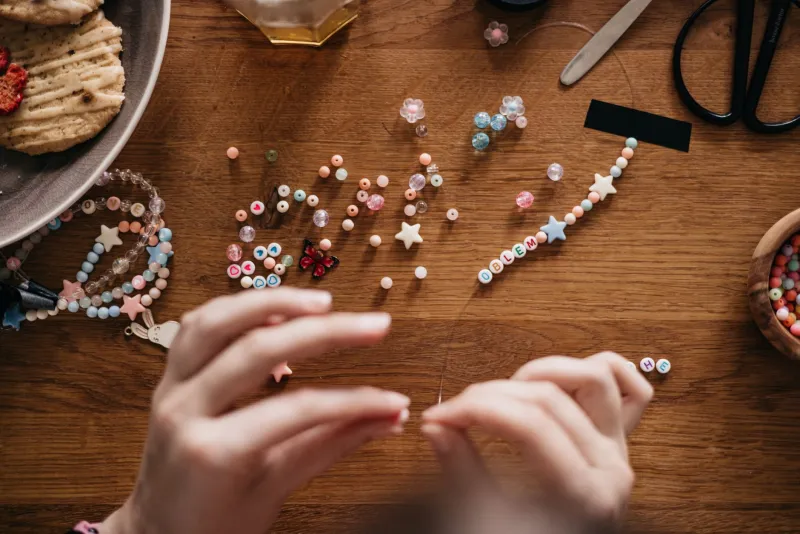
Somewhere around 2023, friendship bracelets became a cultural flashpoint. Yes, partly because of a certain stadium tour and the tradition of trading them in the stands. But zoom out a little and you'll notice something more interesting happening: the bracelets people were making and trading weren't just the knotted embroidery floss kind from summer camp. They were intricate, tiny-beaded things — delicate constructions using Japanese miyuki seed beads and toho beads, following patterns that circulated on TikTok and Pinterest with instructions originally developed by Japanese craft communities.
The aesthetic was unmistakable. Pastel palettes, kawaii iconography, tiny charms sourced from Japanese stationery stores and Korean character shops. These weren't accidental influences. They were the direct result of a generation of American crafters who'd grown up on Japanese and Korean visual culture and were now making things that reflected it.
This is how a craft movement sneaks up on you. Not with a press release, but with a billion small beads and a lot of YouTube tutorials.
The Deep Roots of Japanese Craft Aesthetics
To understand why Japanese craft aesthetics have such a grip on American DIY culture right now, it helps to understand what makes them distinct in the first place.
Japanese craft tradition operates on a philosophy that's almost the opposite of Western mass-production thinking. There's a concept called monozukuri — roughly translated as "the art of making things" — that frames craftsmanship as a form of care, attention, and respect for materials. This isn't just philosophical abstraction; it shows up in the way Japanese craft products are designed and sold. Seed bead brands like Miyuki and Toho produce beads to tolerances so precise that crafters worldwide consider them the gold standard. Japanese stationery and paper craft brands obsess over texture, weight, and finish in ways that feel almost excessive until you hold the product and understand immediately why it matters.
American crafters who discovered these materials through TikTok or Etsy often describe the experience as revelatory. "I didn't know craft supplies could feel like this," one bead artist with a significant TikTok following explained. "Once you use Miyuki beads, you can't go back to the stuff from the big box craft store. The quality difference is just too obvious."
This quality consciousness has spread. American DIY culture, which has historically prized volume and speed — make more, post more, sell more — is developing a new appreciation for the kind of slowness and precision that Japanese craft tradition has always centered.
Korean Character Culture and the Plushie Pipeline
On the other end of the aesthetic spectrum from Japanese minimalist craft is Korean character culture: maximalist, emotionally expressive, unabashedly cute. Characters like Kakao Friends' Ryan and Apeach, Line Friends' Brown Bear, and the sprawling universe of Sanrio (technically Japanese but deeply embedded in Korean pop culture consumption) have generated enormous demand for handmade versions.
On TikTok and Instagram, a whole cottage industry of American crafters has emerged around making plushies, amigurumi (Japanese crochet figures), and fabric goods inspired by Korean and Japanese character IP. Some of these creators sell their work on Etsy; others give it away or trade it at fan conventions. Many do it simply because the process is meditative and the results are adorable.
The crochet amigurumi trend in particular has exploded. Patterns inspired by Sanrio characters, BTS's BT21 lineup, and original kawaii-influenced designs circulate freely through craft communities, with creators translating Japanese and Korean pattern guides into English and adapting them for American yarn and hook sizes. There's a genuinely collaborative, cross-cultural energy to these communities that's pretty rare in internet culture right now.
"I learned to crochet because I wanted to make a Cinnamoroll," one creator in her twenties said matter-of-factly, referencing the Sanrio dog character with the oversized head and floppy ears. "That was my whole motivation. And then I got really into it and now I'm teaching other people how to do it."
The TikTok Acceleration
None of this would have scaled the way it did without TikTok's particular gift for turning niche hobbies into mass phenomena. The platform's algorithm is uniquely suited to craft content: the videos are visually satisfying, the process is inherently time-lapse friendly, and the finished products generate the kind of emotional response ("I need this," "I want to make this," "where do I buy this") that drives shares and saves.
Japanese and Korean craft aesthetics are also just extremely photogenic in the way TikTok rewards. The color palettes — soft pastels, pop-candy brights, strategic neutrals — look great on a phone screen. The finished objects are small enough to hold up to a camera and show detail. The process videos, whether someone is stringing beads or sewing a plushie or folding origami, have an ASMR-adjacent quality that keeps viewers watching.
Craft supply brands have noticed. Japanese and Korean stationery brands that previously had minimal US retail presence have seen demand spike dramatically. Stores like Daiso — the Japanese dollar store chain with locations in several US cities — have become pilgrimage destinations for crafters seeking authentic materials. Online, shops on Etsy and Amazon that import Japanese seed beads and Korean craft supplies have reported significant growth over the last two years.
Community as the Real Product
What's genuinely interesting about this craft wave is that it's not primarily commercial, even though commerce surrounds it. Most of the people making beaded bracelets, crocheting character plushies, or decorating their journals with Japanese washi tape aren't trying to build a business. They're trying to build connection.
Craft circles and swap communities have formed on Discord, Reddit, and TikTok's comment sections. People trade handmade items with strangers across the country. Local meetups organized through social media bring crafters together in coffee shops and community centers. The friendship bracelet trading that happened at concert venues was a visible manifestation of something that's been building in these communities for years: a shared language of making and giving.
There's also something worth noting about the demographics. The crafters driving this wave are predominantly young — teens and people in their twenties — and they're approaching handmade culture with a completely different relationship to "authenticity" than previous generations. They're not romanticizing a pre-industrial past. They're finding genuine satisfaction in making something physical in a world that increasingly feels intangible. The fact that the aesthetic vocabulary they're drawing from is Japanese and Korean isn't incidental — it's part of what makes the things they create feel distinct from mass-produced goods.
Making Something That Looks Like You
Maybe that's the deepest thing this trend is pointing at. American consumer culture has always been about buying identity. This generation is experimenting with making it instead — and the visual languages they're reaching for are ones that feel alive, specific, and genuinely beautiful to them.
Japanese and Korean craft aesthetics didn't conquer American hobby culture through marketing campaigns or corporate strategy. They got there through TikTok tutorials and Etsy shops and Discord servers and the quiet, persistent influence of a generation that grew up watching anime and listening to K-pop and absorbing a whole set of visual values about what handmade things should look and feel like.
The bracelets are cute. But what they represent is a whole generation learning to make something from scratch — and knowing exactly where they got the idea.